Short Version
Curcumin is fat soluble, unstable at intestinal pH and cleared very fast by the liver, so most of a plain dose never reaches the blood in a usable form. Piperine from black pepper slows that clearance dramatically and is the standard fix. A turmeric product with no absorption strategy is working uphill.
Three Reasons It Absorbs Badly
Curcumin fails at every stage of getting into you, which is unusual and worth understanding.
It barely dissolves. Curcumin is fat soluble and almost insoluble in water. In the watery environment of the gut, most of it simply never gets into solution.
It falls apart. At the neutral-to-alkaline pH of the small intestine, curcumin is chemically unstable and degrades within minutes.
The liver clears it immediately. Whatever does get absorbed goes straight to the liver, which attaches sugar and sulphate groups to it for excretion. This is first-pass metabolism, and for curcumin it is brutally efficient.
The result is that plasma curcumin after an ordinary oral dose is often barely detectable. Meanwhile the laboratory literature is enormous, because in a dish curcumin does a great many interesting things at concentrations a person will never reach.
What Piperine Does
Piperine is the alkaloid that makes black pepper hot. It inhibits the liver and intestinal enzymes responsible for that first-pass clearance, particularly glucuronidation.
The frequently quoted figure is a two thousand per cent increase in curcumin bioavailability from adding a small amount of piperine, from a study using 20 mg of piperine with 2 g of curcumin. That specific number is quoted more confidently than one study warrants, and the direction of the effect is not in dispute.
It is also why traditional Indian cooking pairs turmeric with black pepper and with fat, which is a reasonable delivery system arrived at without any pharmacology.
The caution nobody mentions. Piperine works by inhibiting drug metabolising enzymes. That is exactly how grapefruit interacts with medication. A piperine-enhanced supplement can raise blood levels of other drugs you take, and that is worth a pharmacist’s attention rather than being treated as a free upgrade.
The Other Approaches
- Phospholipid complexes. Curcumin bound to phosphatidylcholine, sold under branded names. Reasonable human data behind several of them.
- Liposomal and micellar formulations. Curcumin packaged inside fat droplets. Effective in principle, and quality varies enormously between products.
- Nanoparticle formulations. Smaller particles, more surface area, better dissolution.
- Simply eating it with fat. Free, and it does help, because curcumin is fat soluble. It does nothing about the liver clearance.
How To Read A Turmeric Label
- Root or extract? Raw turmeric root is 2 to 5 per cent curcuminoids. A standardised extract is 95 per cent. That is a twenty-fold difference in the compound that matters, and the words look nearly identical on a panel.
- Is a curcuminoid percentage stated? If not, assume root powder.
- Is there an absorption strategy? Black pepper extract, piperine, a branded phospholipid complex, or a liposomal claim. If none of those appear, there is not one.
- How much, against the trials? Human studies use 500 to 1,500 mg of standardised extract daily. Compare that against what the label actually declares.
Applying That To This Formula
Turmeric Root is one of fourteen names sharing a 500 mg blend, declared as turmeric root rather than as a standardised extract. There is no black pepper, no piperine and no liposomal claim anywhere on the panel.
Three strikes: a small amount, probably the low-curcuminoid form, with no absorption help. Whatever turmeric is doing here, it is not reproducing the trial literature, and the arithmetic article puts a number on the first of those three.
That is not a reason to avoid the product. It is a reason not to buy it for the turmeric.
What Turmeric Is Actually Good For
Worth ending here, because this article has been hard on it.
At proper doses with an absorption strategy, curcumin has moderate evidence for reducing inflammatory markers and for joint pain. That is a real, useful, unglamorous finding.
Its blood sugar evidence is much weaker and runs indirectly through inflammation. On a glucose panel it is a supporting ingredient at best, which is exactly how its page here grades it.
Questions On This Article
What readers ask after reading it.
Why is curcumin so poorly absorbed?
It barely dissolves in water, it degrades at intestinal pH, and the liver clears whatever gets through almost immediately. It fails at all three stages.
Does black pepper really help?
The direction of the effect is well established: piperine inhibits the enzymes that clear curcumin, raising blood levels substantially. The specific 2000%% figure comes from one study and is quoted more confidently than that warrants.
Is piperine safe?
It works by inhibiting drug-metabolising enzymes, which is the same mechanism behind grapefruit interactions. Anyone on medication should raise it with a pharmacist.
What is the difference between turmeric root and curcumin extract?
Root powder is 2 to 5 per cent curcuminoids; a standardised extract is 95 per cent. That is roughly a twenty-fold difference in the active compound.
Does turmeric help blood sugar?
Weakly and indirectly, through inflammation rather than glucose handling. Its stronger evidence is in joint pain and inflammatory markers.
Three More Articles
Ingredients Named Above
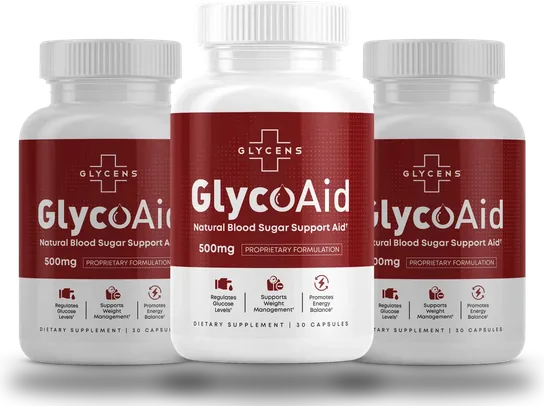
Order Your GlycoAid Today
One capsule with a meal, a page for every name on the label, and sixty days to send it back if it does nothing.
- One capsule a day, taken with food
- Fourteen names, every one with its own page here
- Free US delivery on the 3 and 6 bottle packs
- Sixty days to send it back, opened bottles included