Home›Inside The Blend
How GlycoAid Works, Mechanism By Mechanism
Five claimed routes. One is genuinely well characterised, two are plausible at this dose, one is ordinary nutrition and one barely registers.
Short Version
The mechanism with the best science behind it — berberine on AMPK — is the one this blend is least able to deliver. The mechanisms most likely to be working here are the gut-enzyme ones and the two micronutrients. That inversion is the whole story of this product.
Mechanism One: AMPK Activation
Berberine is proposed to switch on AMPK, a cellular energy sensor. When AMPK is active, cells take up more glucose and the liver releases less. It is the best-characterised pathway on this label and it has real randomised trials behind it.
The catch: those trials used 900 to 1,500 mg a day, split into two or three doses. This entire blend weighs 500 mg and holds thirteen other things. The mechanism is excellent. The delivery is not.
Grade: strong mechanism, almost certainly under-delivered here.
Mechanism Two: Slowing Carbohydrate Digestion
This is the one most likely to actually be happening. White mulberry leaf contains DNJ and banaba leaf contains corosolic acid, and both inhibit alpha-glucosidase — the intestinal enzyme that breaks starch into absorbable glucose.
Partially block that enzyme and starch digests more slowly, so the glucose behind a meal arrives as a slope rather than a spike. It is the same enzyme target as acarbose, a prescription drug.
Crucially, both work at doses a 500 mg blend can genuinely carry: 32 to 48 mg for banaba, a few hundred milligrams for mulberry. This is the mechanism to actually expect something from, and the predictable side effect — gas from fermenting undigested carbohydrate — is the sign it is working.
Grade: moderate, and plausible at this dose.
Mechanism Three: Taste And Craving
Gymnema occupies the sweet receptors on the tongue for thirty minutes to two hours, so sweet food tastes of almost nothing. This is a real, immediate, testable effect and it is the only thing on this label you can verify yourself.
Its research dose is 200 to 400 mg, which a 500 mg blend could carry if gymnema took most of it. Whether it does is unknown, and the sixty-second tongue test is how you find out.
Grade: strong effect where present, presence unconfirmed.
Mechanism Four: Nutrition Doing Nutrition
Chromium supports the action of insulin at the cell and has an official adequate intake. Biotin carries approved wording for contributing to normal macronutrient metabolism.
Neither is dramatic and neither is fake. They do what nutrition does: they fill a requirement. If you were not short of them, filling that requirement will not feel like anything. Both are micrograms by weight, so unlike the botanicals there is no arithmetic reason they cannot be at proper amounts.
Grade: strong as nutrition, quiet as an experience.
Mechanism Five: Antioxidant And Anti-Inflammatory Support
Turmeric, goji berry and alpha-lipoic acid all contribute polyphenols and antioxidant compounds. Chronic low-grade inflammation is genuinely part of the picture in insulin resistance, so the reasoning is not invented.
It is, however, indirect, and the doses are far below the trials. Turmeric has the additional problem that curcumin absorbs badly and this formula contains no piperine to help it.
Grade: real nutrition, negligible as an intervention at this dose.
What Adding Them Up Gives You
A capsule whose honest job is to sit alongside eating changes and make them slightly easier to hold. The gut-enzyme effect is the one most likely to be doing real work, the two micronutrients are certainly present, and the famous names are almost certainly token.
That is a narrower claim than the packaging makes and a considerably more believable one. Anything beyond it — regulating glucose, replacing medication, results without changing anything — is not supported by this label and is not claimed here.
Does it work if I change nothing else? Probably not in any way you would notice. The mechanism most likely to be active affects how fast a meal is digested, and that only matters if there is a meal to affect. A capsule taken on top of an unchanged week is an expensive way to avoid the obvious conversation.
Mechanism Questions
Whatever this section leaves people wondering about.
Does GlycoAid regulate blood sugar?
It is sold as support for glucose already within a normal range, which is a different and much narrower statement. It is not a treatment for diabetes and it does not regulate anything in the medical sense of that word.
Which ingredient does the most work?
Probably the gut-enzyme pair, banaba and white mulberry, because they are the only ones whose research doses a 500 mg blend can genuinely carry.
Why is berberine not doing the heavy lifting?
Because its trials used 900 to 1,500 mg a day, which is two to three times the weight of the entire blend. The mechanism is strong; the amount cannot be.
How long before it does anything?
The gut-enzyme effect is immediate at each meal, if it is present. Anything measured in a blood test takes weeks, and four weeks is a fair first read.
Will it work without changing my diet?
Unlikely to be noticeable. The mechanism most likely to be active is about how a meal is digested, so there has to be a meal for it to act on.
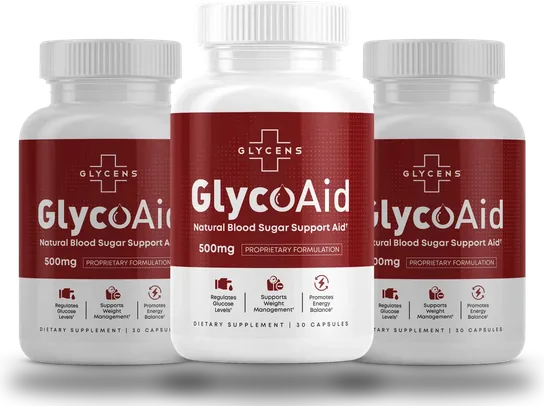
Order Your GlycoAid Today
One capsule with a meal, a page for every name on the label, and sixty days to send it back if it does nothing.
- One capsule a day, taken with food
- Fourteen names, every one with its own page here
- Free US delivery on the 3 and 6 bottle packs
- Sixty days to send it back, opened bottles included